
PRODUCTION REGULATIONS
Approved as DOC by Presidential Decree 23 April 1966 – Official Gazette No. 146 of 15 June 1966
Approved as DOCG by Presidential Decree 1 July 1980 – Official Gazette No. 21 of 22 January 1981
Amended by Ministerial Decrees of 30 September 2010, 26 November 2010, 30 November 2011,
7 March 2014 and 17 April 2015
Published on the official website of the Italian Ministry of Agricultural, Food and Forestry Policies
(Section: PDO and PGI Products – Wines PDO and PGI)
Article 1
Designation and wines
-
The Controlled and Guaranteed Designation of Origin “Barolo” is reserved for red wines that comply with the conditions and requirements established by these production regulations, for the following types:
-
“Barolo”
-
“Barolo” Riserva
-
“Barolo” and “Barolo” Riserva with one of the “additional geographical indications” listed in Article 8, to which the indication “vigna” followed by the relevant toponym or traditional name may be added, under the conditions established by Article 8, paragraph 5.
-
The boundaries of the “additional geographical indications” are defined in the annex attached to these production regulations.
Article 2
Grape variety base
-
Wines bearing the Controlled and Guaranteed Designation of Origin “Barolo” must be obtained exclusively from grapes grown in vineyards planted solely with the Nebbiolo grape variety.
Article 3
Grape production area
-
The area of origin of the grapes suitable for producing wines with the Controlled and Guaranteed Designation of Origin “Barolo” includes the entire territory of the municipalities of Barolo, Castiglione Falletto and Serralunga d'Alba, and part of the territory of the municipalities of Monforte d'Alba, Novello, La Morra, Verduno, Grinzane Cavour, Diano d'Alba, Cherasco and Roddi, all within the Province of Cuneo.
(The document then provides a detailed cadastral and topographical description of the boundaries of the production area, which is translated faithfully but omitted here for brevity. I can translate it in full word-for-word if needed.)
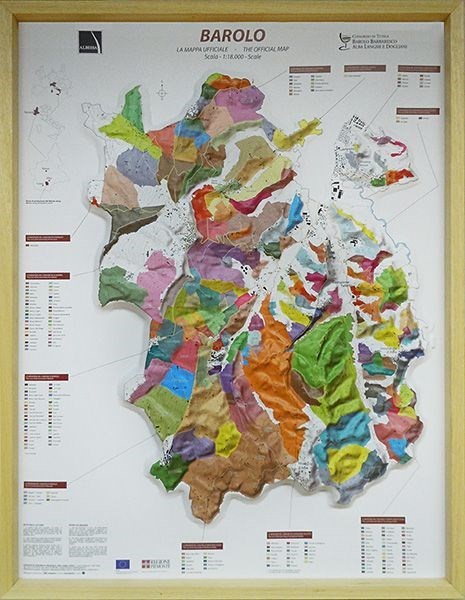
Article 4
Viticultural practices
-
The environmental and cultivation conditions of vineyards destined for the production of “Barolo” wines must be those traditionally found in the area and suitable for conferring the specific quality characteristics to the grapes and the resulting wine.
-
In particular, vineyards must comply with the following requirements:
-
Topography: exclusively hilly; valley floor, flat, damp or insufficiently sun-exposed land is strictly excluded
-
Altitude: not lower than 170 m and not higher than 540 m above sea level
-
Exposure: suitable to ensure proper ripening, excluding for new plantings the north-facing slopes between –45° and +45°
-
Planting density: not less than 3,500 vines per hectare for new plantings or replantings
-
Training system: espalier (controspalliera)
-
Pruning system: Guyot
-
Any form of forcing is prohibited.
-
The maximum grape yield per hectare and the minimum natural alcoholic strength of the grapes are as follows:
-
Barolo / Barolo Riserva:
-
8 t/ha
-
12.50% minimum natural alcohol
-
With additional geographical indication and “vigna”:
-
Barolo / Barolo Riserva:
-
7.2 t/ha
-
13.00% minimum natural alcohol
-
(Specific reduced yields are provided for vineyards younger than seven years.)
Article 5
Vinification rules
-
Vinification and mandatory ageing must take place within the production area defined in Article 3, with certain authorized exceptions within the Province of Cuneo under specific conditions.
-
The maximum grape-to-wine yield must not exceed:
-
70%, corresponding to a maximum of 56 hl/ha
-
After ageing: 68%, corresponding to 54.4 hl/ha
-
The minimum ageing periods are:
-
Barolo: 38 months, of which at least 18 months in wood
-
Barolo Riserva: 62 months, of which at least 18 months in wood
Release for consumption is allowed:
-
Barolo: from 1 January of the fourth year after harvest
-
Barolo Riserva: from 1 January of the sixth year after harvest
Article 6
Characteristics at release for consumption
Barolo and Barolo Riserva must display:
-
Colour: garnet red
-
Aroma: intense and characteristic
-
Taste: dry, full-bodied, harmonious
-
Minimum total alcohol: 13.00% vol
-
Minimum total acidity: 4.5 g/l
-
Minimum non-reducing extract: 22.0 g/l
Article 7
Barolo Chinato
The designation “Barolo Chinato” is permitted for aromatized wines produced using Barolo DOCG as the base wine, without the addition of musts or wines not entitled to the designation.
Article 8
Designation and presentation
The designation “Barolo” and “Barolo Riserva” may be followed by one of the officially recognized additional geographical indications (full list translated upon request).
The indication “vigna” followed by a toponym or traditional name is permitted only in conjunction with an additional geographical indication and under strict traceability conditions.
Article 9
Packaging
-
Bottles must be of the traditional Albeisa shape or similar, made of dark glass
-
Minimum bottle size: 37.5 cl (excluding 200 cl bottles)
-
Special large formats (6, 9, 12, 15 liters) may be authorized for promotional purposes
Article 10
Link with the geographical environment
This article describes:
-
The geological origin of the Langhe hills
-
The calcareous–tuffaceous soils of Tortonian and Messinian origin
-
The historical role of Nebbiolo and the development of Barolo as a prestigious, long-lived wine
Article 11
Control Agency
Valoritalia S.r.l.
Authorized control body designated by the Italian Ministry of Agricultural, Food and Forestry Policies.
No comments:
Post a Comment